
 Animalia Team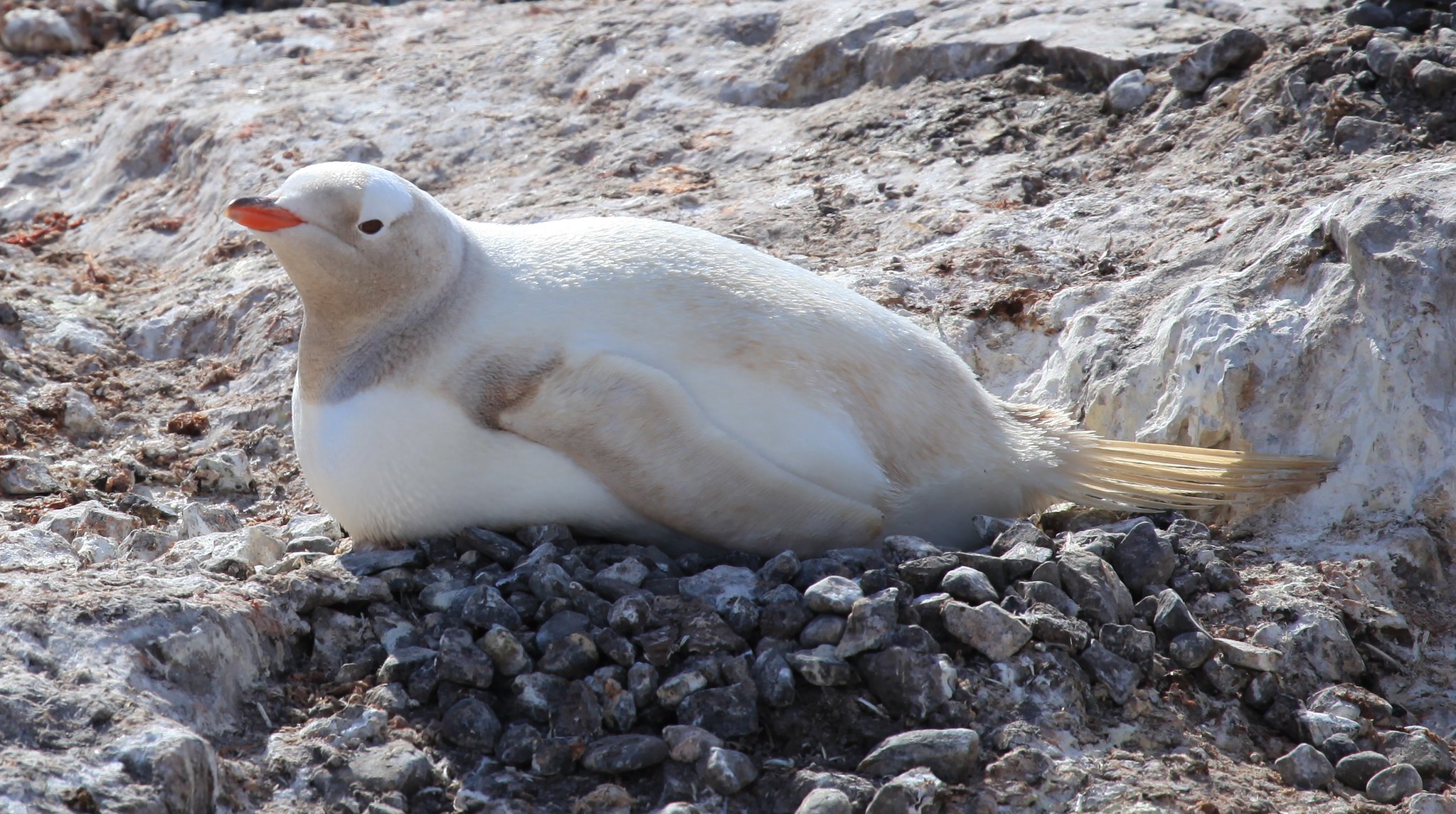
A sheet of Antarctic gray stretches to the horizon, ice grinding against ice, wind skimming the surface like a blade. Out of that near-colorless sprawl rises a figure that seems misplaced, a penguin washed in warm gold. Against black backs and white bellies, this bird glows. The golden penguin stands as a living contradiction, a splash of sunlight in a world built on contrast.
The sight traveled quickly, shared in still images and whispered awe. Yet the color that turned this bird into a global fascination came from a quiet genetic twist rather than myth. The golden penguin is a leucistic penguin, a rare variation that drains dark pigment and leaves behind a soft halo of yellow and cream. In colonies defined by uniformity, the effect is electric.
In colonies that can number in the tens of thousands, uniformity is a form of safety. The golden penguin breaks that code from the instant it hatches, carrying a genetic variation that reshapes both its appearance and its fate.
A Genetic Twist Beneath the Feathers
Leucism is often confused with albinism, but the difference matters. A leucistic penguin does not lack pigment entirely. Instead, melanin fails to deposit normally in feathers, muting the deep blacks and leaving behind creamy whites and warm yellows. Eyes remain dark, vision intact, and skin pigmentation stays largely normal.
This subtle distinction allows the golden penguin to function physically like any other member of its species. It swims with the same torpedo precision, hunts the same krill-rich waters, and endures the same punishing cold. Yet visually, it stands apart in a world where camouflage and conformity play silent roles in survival.
Leucistic penguins are exceedingly rare. Estimates suggest that only one in several hundred thousand penguins displays this coloring, making each sighting feel almost mythic. When researchers or photographers encounter one, the images ripple quickly across the globe, igniting fascination far beyond the icy shoreline.
Born Into Contrast
Penguin colonies are places of motion and sound. Calls ricochet across rocks, bodies jostle for space, and the ground seems alive with black-and-white movement. In this visual chorus, a golden penguin appears almost unreal, as if cut from another landscape entirely.
Chicks with leucism emerge looking paler than their siblings, though the full effect often deepens with age. As adult plumage comes in, the contrast sharpens. What should be coal-dark becomes pale honey. What should be stark white turns creamy and luminous.
This difference does not go unnoticed by other penguins. Studies and field observations suggest that unusual coloration can affect social interactions, from mating opportunities to positioning within the colony. Penguins rely heavily on vocal cues, which helps level the field, but visual signals still carry weight in displays and pair bonding.
Predators and the Price of Visibility

In the water, penguin coloration serves a purpose known as countershading. Dark backs blend with the depths when seen from above, while white bellies mirror the light filtering down when viewed from below. A golden penguin disrupts that balance.
For predators like leopard seals or orcas, a lighter silhouette can be easier to track, especially in clear or shallow waters. While hard data on predation rates for leucistic penguins remains limited, biologists agree that increased visibility likely raises risk, particularly during the vulnerable juvenile years.
On land, the danger shifts. Skuas and giant petrels patrol breeding grounds, scanning for weakness or difference. A pale chick can draw attention, standing out against the stony terrain like a dropped feather.
Survival, for the golden penguin, becomes an exercise in constant exposure.
Love and Longevity in a Black-and-White Society
Mating among penguins is a choreography of sound, posture, and persistence. Partners recognize each other by voice, returning year after year to reunite amid the chaos. For a leucistic penguin, this vocal reliance offers a crucial advantage.
Documented cases show that golden penguins do form pairs and successfully raise chicks. Some have been observed returning to the same colonies across multiple breeding seasons, suggesting that their coloring, while unusual, does not doom them to isolation.
Still, the path is narrower. If visual cues influence mate choice even slightly, rarity becomes a hurdle. The golden penguin must compete in a system designed around uniform signals, where standing out can be both a beacon and a barrier.
When Science Meets Spectacle
The modern legend of the golden penguin owes much to photography. In January 2012, on the icy edges of the Aitcho Islands in Antarctica, a strange figure moved through a colony of chinstrap penguins. Against the familiar black backs and white bellies, one bird looked almost unreal. Its feathers were pale and washed out, creamy where bold contrast should have been. It stood apart instantly, like a mistake in a perfectly printed photograph.

The penguin was photographed during a Lindblad National Geographic expedition, with naturalist David Stephens capturing images that quickly spread beyond the ice. At first glance, many assumed albinism, but the explanation was more precise. The bird was leucistic, a rare genetic condition that reduces melanin in feathers while leaving the eyes dark. The result was a chinstrap penguin stripped of its signature markings, softened into ghostly tones.
Despite its unusual appearance, the pale penguin appeared healthy and fully integrated into the colony. It walked, rested, and behaved no differently from the others clustered along the frozen shoreline. For scientists, the sighting added to a small but growing record of pigment anomalies in penguins. For everyone else, it was a fleeting reminder that even in Antarctica’s rigid monochrome world, nature occasionally breaks its own rules.
Climate Change and an Uncertain Future
As polar environments shift, all penguins face mounting challenges. Shrinking sea ice, warming waters, and changing prey distribution tighten the margins of survival. For a golden penguin, already navigating heightened visibility and rarity, environmental stress adds another layer of uncertainty.
Leucism itself does not weaken a penguin’s physiology. But in a world where conditions grow harsher, even small disadvantages can compound. Longer foraging trips increase exposure to predators. Reduced food availability tests endurance. Breeding failures echo across seasons.
The survival of leucistic penguins ultimately mirrors the fate of their colonies. Their presence is not an anomaly outside the system, but a fragile thread woven into it.
A Living Contrast on the Ice
The golden penguin does not blaze or glitter. Its beauty is quieter, a soft radiance against snow and stone. It walks, swims, and calls like any other penguin, carrying its difference without ceremony.
In a monochrome world shaped by extremes, the leucistic penguin endures as a living contrast, proof that even in the most uniform landscapes, nature leaves room for variation. Its survival is not guaranteed, nor is it symbolic of hope or warning. It simply exists, pale and persistent, moving through ice and water with the same ancient determination as its darker kin.
And when it appears on a distant shore, for those brief moments before it blends back into the colony, the Antarctic seems to hold a little more light.


